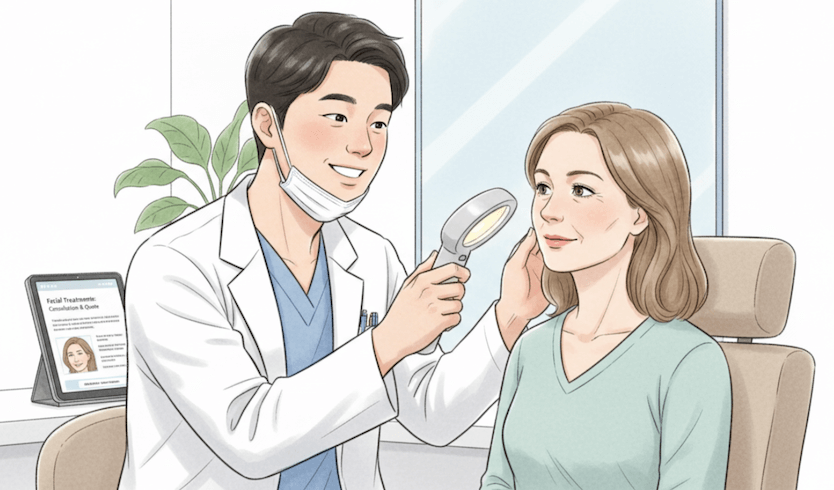
You've been staring at your jawline on Zoom calls wondering if something non-surgical could actually do something. Two devices dominate Seoul's top clinics right now: Thermage FLX and Ultherapy — both FDA-cleared, both promise zero downtime.
Here's what nobody leads with: they do fundamentally different jobs. Picking the wrong one won't hurt you, but it might seriously underwhelm you. Here's how to choose yours.
RF vs. Ultrasound: They're Targeting Completely Different Things
These two devices don't actually compete — they target completely different addresses inside your face. Thermage FLX sends monopolar radiofrequency heat into the dermis at 2.4–4.3 mm deep, contracting existing collagen on contact and triggering a fresh rebuild over the next 3–6 months . The payoff: smoother texture, a firmer surface, and softer fine lines.
Ultherapy goes lower, firing micro-focused ultrasound down to the SMAS layer at up to 4.5 mm — the same fibromuscular layer a surgeon physically lifts during a traditional facelift . That depth is what separates a true structural lift from surface skin tightening.
NYC dermatologist Dr. Heidi Waldorf puts it plainly: "When more tightening is needed, I turn to Ultherapy — it lets me target multiple levels of deeper tissues" . Thermage FLX is FDA-cleared for skin tightening across face and body; Ultherapy carries specific clearance for brow lift, chin, neck, and décolletage lines .
| Item | Thermage FLX | Ultherapy |
|---|---|---|
| Target layer | Dermis (2.4–4.3 mm) | SMAS (up to 4.5 mm) |
| Technology | Monopolar RF | Microfocused ultrasound |
| Best for | Texture, fine lines, surface firmness | Sagging, jaw and brow lift |
| Results peak | 3–6 months | 2–3 months |
| Longevity | Up to 12 months | 6–12 months |
| FDA clearance | Face + body tightening | Brow, chin, neck, décolletage |
| Pain level | Mild heat sensation | Moderate (deeper delivery) |
The easiest analogy: Thermage irons the fabric, Ultherapy re-stitches the lining underneath — book a consult with a board-certified dermatologist to find out which layer you actually need to address.
The Price Gap Is Real — and You're Getting the Exact Same Device
A credentialed Seoul clinic puts you under the exact same Solta Medical handpiece as your derm stateside — same pulse protocol, same results ceiling . The only variable is the price.
Seoul pricing scales with pulse count; higher pulses push toward the $1,800 ceiling . Under $600 for a full face often signals counterfeit handpieces or older non-FLX units — ask to see the FLX serial number before you book.
Combo packages are common: Thermage paired with Botox, or staggered alongside Ultherapy three to six months later. Clinics typically offer these bundles at a rate well below separate bookings.

Which One Is Actually Right for Your Face?
It comes down to what you're trying to fix. Thermage FLX is ideal for early-to-mid 30s skin — mild laxity, texture concerns, and a lower pain threshold.
Ultherapy is for structural concerns — jowling, neck droop, brow heaviness. Dr. Jihye at Forena Clinic Seoul calls it "more effective for deeper lifting, especially the lower face and neck."
The smartest move? Combine both, staggered 3–6 months apart — a protocol top Seoul clinics increasingly recommend. Thermage FLX holds a 79% "Worth It" on RealSelf , and layering both addresses every depth.

Timeline, Pain, and How to Plan Your Seoul Trip Around It
Both are walk-in, walk-out — no anesthesia, no downtime. Mild redness can appear for up to 48 hours but typically clears overnight.
Thermage FLX delivers visible tightening the same day, with peak results at 3–6 months and longevity of 12–24 months per session . Ultherapy's lift builds over 2–3 months and lasts roughly 6–12 months.
Pain is the real differentiator. Thermage FLX runs warm; Ultherapy goes deeper and hits noticeably harder. Seoul clinics offer topical anesthetic or oral pain relief pre-session .
💡 Disclose pacemakers, metal implants in the treatment area, or pregnancy before booking — contraindications for both procedures.
Plan your session on day two in Seoul so any redness fades first. Either way, most people walk out looking like they did nothing at all.
Most Seoul dermatologists advise spacing Thermage FLX and Ultherapy 3–6 months apart, giving each treatment's collagen remodeling cycle room to fully complete before layering on another round of stimulation. Stacking both in one trip isn't inherently dangerous, but you'd be doubling the spend without doubling the results. The smarter play: prioritize your bigger concern on this visit — Ultherapy for visible sagging, Thermage FLX for texture and mild laxity — and schedule the second treatment back home or on a return trip.
Ask to see the Solta Medical device registration certificate (Thermage FLX's manufacturer) and have staff match the handpiece serial number to the machine sitting in the treatment room. Full-face pricing below ₩800,000 (~$580 USD) is a concrete red flag — authentic FLX hardware carries real operating costs that floor the price. Reputable clinics will also hand you a written pulse-count breakdown before you commit, so scope and price are locked. If a clinic resists either request, that tells you everything.
At that stage, Thermage FLX works more as preventive collagen-banking and texture refinement than a dramatic lift — improvement builds over 3–6 months and results hold for 1–2 years depending on your skin. The value math still lands: a full-face session in Seoul runs $600–$1,350 versus $2,500–$4,500 stateside, and it's FDA-cleared for all skin types. If you're already making the Korea trip, adding it to the itinerary is a genuinely reasonable move rather than a stretch.
Standard protocol at reputable Seoul clinics starts with topical numbing cream applied 30–60 minutes before treatment, often paired with oral analgesics; higher-end practices offer IV sedation for the most sensitive zones — typically the jaw and cheekbone-adjacent areas where bone conducts heat. The deep SMAS-layer pulses still register as sharp, brief jolts — that part is just physics — but the premedication genuinely turns a potentially brutal 60–90-minute session into something most patients describe as intense but manageable once the numbing fully kicks in.