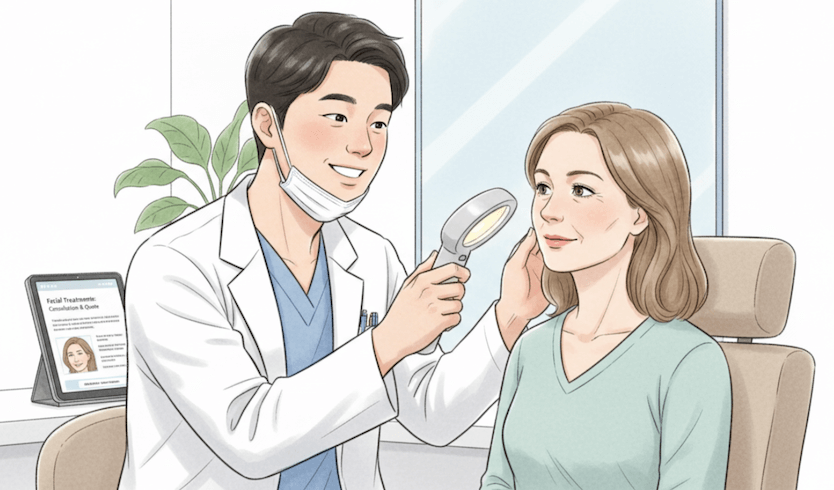
Seoul’s RF menus can make a $3,000-plus U.S. Thermage quote look negotiable—but is Oligio the same treatment, and is the saving real?
Here’s how to compare the device, shot count, clinician, recovery plan, and fine print before you book around a Korea trip.
First, the FDA label does not settle the Oligio-versus-Thermage question
Thermage FLX is FDA 510(k)-cleared, not PMA-style “approved”—a meaningful distinction that gets lost in treatment menus. Its 2017 clearance reflects a substantial-equivalence review.
Oligio X is not Korea-only or unregulated: it received its own FDA 510(k) clearance in 2024. That status permits marketing under the cleared device record; it does not turn every tightening claim into an FDA finding.
FDA registration by itself is neither clearance nor approval, and clearance attaches to a specific device and indication.
Here’s the practical takeaway: neither record proves Oligio and Thermage deliver equivalent cosmetic tightening for every face, age, or protocol. Ask your provider for the exact model, intended use, settings, and a realistic plan for your skin.
The Seoul price comparison only works when the shot count matches
Oligio: $770–$2,150 for 600 full-face shots; $1,540–$2,900 for 900 face-and-neck shots. Shot count changes the deal.
U.S. Thermage averages $3,188, with reported pricing of $1,500–$7,900. Compare matched zones.
| Item | Oligio | Thermage |
|---|---|---|
| Price | $770+/600 | $3,188 avg |
| Shots | 600 or 900 | Match count |
| Zone | Face/neck | Match zone |
| Model | Exact model | Exact model |
| Risk | Sealed tip | Sealed tip |
Get VAT, numbing, aftercare, add-ons, and U.S. follow-up in writing. Confirm the exact model’s FDA 510(k) status and sealed-tip authenticity.
Pain and downtime are usually manageable—but burns are the risk worth discussing
Expect quick, pulsing heat—not a spa nap. One Seoul patient said 900 Thermage shots were tolerable with numbing cream, though the smile lines felt hotter; that is personal experience, not clinical proof.
Most people return to normal activity quickly, but temporary redness and mild swelling can show up. Ask whether topical numbing, cooling, real-time feedback, and energy adjustments are part of the plan.
Before treatment, clarify who is operating the device, who can lower the energy, and whether you can pause or stop at any point. Those answers matter more than bravado about “painless” RF.
⚠️ Burns, blisters, scabbing, altered sensation, and scarring are uncommon but material risks. An FDA adverse-event report described a Thermage FLX complaint involving a potentially overheated tip.
Choose a clinic with a clear aftercare and complication plan—especially if you are flying home soon after.
Expect gradual refinement, not a non-surgical facelift
Think refinement, not a rewind button. Thermage can create an early tightening effect, but collagen-led improvement commonly develops over about 2–6 months; the manufacturer describes results lasting roughly 1–2 years.
Oligio also appears gradual, but its longer-term cosmetic longevity is less firmly established in the supplied evidence. In your 20s or 30s, especially with minimal laxity, the change may be subtle—and RF cannot recreate surgical lifting for moderate-to-severe looseness.
A strong consultation should make the expected degree of change feel clear, not vague. Before booking, ask the provider to document your device, credentials, and aftercare plan in writing.
No. Oligio X is 510(k)-cleared, not FDA-approved, and its clearance does not list facial tightening.
Match area, shots, model, VAT, sealed tip, and clinician; Seoul Oligio can run $770–$2,150 for 600 shots.
Numbing is optional; plan for 0–2 days of redness or swelling, though most people resume normal activity right away.
Expect gradual change over 2–6 months; Thermage may last 12–24 months, while Oligio data reaches six months.